
phone +91-9868001440

  • NAAS Rating 2026- BF 4.96 | IJTAS 3.74 | IJET 3.85
  • NAAS Rating 2026 - BF 4.96 | IJTAS 3.74 | IJET 3.85
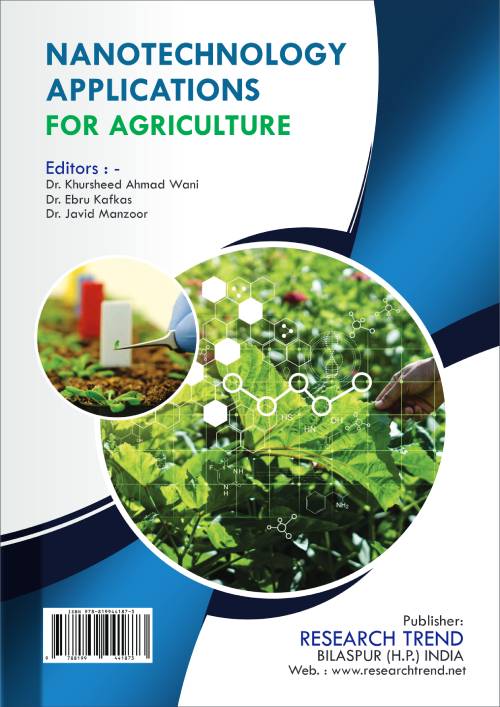
  • NAAS Rating 2026 - BF 4.96 | IJTAS 3.74 | IJET 3.85

Nanotechnology Applications for Agriculture

Nanotechnology Applications for Agriculture

Authors: Dr. Khursheed Ahmad Wani, Dr. Ebru Kafkas, Dr. Javid Manzoor
Edition: 1st Edition
First Published: 2025
eBook Published: 2025-10-15
Location: Himachal Pradesh, India
Imprint: Research Trend
Pages: 87
DOI: https://doi.org/10.65041/RT2025/978-81-994418-7-3
ISBN: 978-81-994418-7-3
Subjects: Agriculture

About this Book

Nanotechnology Applications for Agriculture is a cutting-edge scholarly volume that explores how nanoscale science and engineering can transform agricultural systems for greater productivity, environmental sustainability, and resilience in the face of global challenges such as food security and climate change. The book brings together multidisciplinary research and expert perspectives on the deployment of nanomaterials, nanoscale technologies, and nano-enabled systems in modern agriculture.
Nanotechnology defined as the manipulation and application of materials at scales of 1–100 nanometers offers transformative potential in plant production, nutrient management, pest and disease control, soil and water remediation, sensor technologies, and sustainable farming strategies. By integrating principles from materials science, agronomy, environmental science, and biotechnology, this volume showcases both foundational science and application-oriented innovations that address key needs of 21st-century agriculture.

Chapters

Chapter 1 | 9 pages

Nanomaterials for Crop Improvement and Protection

By: Karçiçeği Gerger 1 , Nazlıcan Bahar 2 and Bilal Ahmad Wani 3
Abstract
Modern agriculture has many complex problems, and nanotechnology has emerged as a ground-breaking answer that offers creative ways to boost agricultural output while advancing environmental sustainability. This chapter offers a thorough analysis of the uses of nanomaterials in crop protection and development, examining their advantages, disadvantages, and modes of action in agricultural systems. High surface area-to-volume ratios and increased reactivity are only two of the special physicochemical characteristics of nanomaterials that show great promise for increasing nutrient delivery using nanofertilizers that increase absorption efficiency and lower environmental losses. By directly controlling pathogens and triggering plant defense systems, their antimicrobial qualities allow for efficient disease management and provide substitutes for traditional chemical pesticides. By altering antioxidant systems and enhancing physiological reactions, nanomaterials also increase crop resistance to abiotic challenges including heat, salt, and drought. Cutting application rates and increasing effectiveness, advanced nanocarrier technologies provide targeted and regulated pesticide delivery. Adoption of agricultural nanotechnology, however, requires careful evaluation of possible health and environmental hazards, which calls for thorough safety evaluations and the creation of suitable regulatory frameworks. This chapter summarizes the state of the art regarding the use of nanomaterials in agriculture, talks about safety issues and environmental effects, and suggests future lines of inquiry for creating sustainable agricultural technologies enabled by nanotechnology that can reduce ecological footprints and increase global food security.
Chapter 2 | 10 pages

Nano-Fertilizers and Sustainable Nutrient Management

By: Naseem Ahmed 1 , Yogesh Kumar Walia 2 , Dheeraj Vasu 3 , Deepak Kumar 4 , Kamal Kishore 5 and Ajay Kumar Gautam 6
Abstract
Conventional fertilizers' inefficiency is a major problem in contemporary agriculture; nutrient utilization efficiencies are often less than 50%, which results in large financial losses and environmental damage. By delivering vital nutrients to crops in a regulated and targeted manner, nano- fertilizers have become a promising technology that has the potential to completely transform nutrient management. The creation, varieties, workings, and uses of nano-fertilizers in sustainable agriculture are examined in this chapter. Through increased plant absorption, gradual and sustained release mechanisms, and decreased environmental losses from leaching, volatilization, and fixing, nano-fertilizers increase the efficiency of nutrient usage. Numerous formulations, such as fertilizers based on nanoparticles, nutrients encapsulated in nanoparticles, and coating technologies at the nanoscale, provide flexibility in meeting particular nutritional needs for various crops and soil types. The physiological and molecular processes that underlie the efficacy of nano-fertilizers, their effects on microbial populations and soil health, and their contribution to increased crop quality and yield are all covered in this chapter. The practical use of nano- fertilizers is assessed by critically analyzing economic viability, environmental effects, and regulatory issues. While issues like standardization, safety evaluation, and farmer uptake are addressed, case studies show effective implementations in significant agricultural systems. In order to create economically and ecologically sustainable nano-fertilizer technologies that can support global food security while preserving natural resources, the chapter ends by defining future research goals.
Chapter 3 | 11 pages

Nanotechnology in Soil Remediation and Water Treatment

By: Bhagat Singh
Abstract
One of the biggest problems of the twenty-first century is environmental pollution of soil and water resources, which endangers human health, ecosystem integrity, and sustainable development. Due to their high cost, lengthy treatment periods, and poor efficacy against newly discovered pollutants, traditional cleanup procedures often prove insufficient. Because of the special physicochemical characteristics of nanomaterials, nanotechnology has become a ground-breaking method that offers previously unheard-of potential for environmental cleaning. This chapter offers a thorough analysis of the underlying ideas, kinds of materials, mechanisms of action, and real-world applications of nanotechnology in soil remediation and water treatment. The topic covers a range of nanomaterials, such as metal oxide nanoparticles, carbon- based nanomaterials, zero-valent iron nanoparticles, and nanocomposites, as well as their methods of removing contaminants, such as chemical reduction, adsorption, and catalytic degradation. Even while nanotechnology shows great promise in terms of improved reactivity, selectivity, and efficiency when compared to traditional techniques, important factors like cost-effectiveness, scalability, and environmental safety still need to be taken into account. This chapter summarizes existing research, points out areas for improvement, and offers outlooks for the long-term use of nanotechnology in environmental remediation.
Chapter 4 | 12 pages

Nano-Enabled Biosensors for Pest and Disease Detection

By: Manas K. Dhal
Abstract
This chapter explores the fundamental principles, design strategies, and applications of nano- enabled biosensors in agricultural diagnostics. Nanomaterials such as gold nanoparticles, quantum dots, carbon nanotubes, graphene, and magnetic nanoparticles have been extensively utilized to enhance biosensor performance through improved signal transduction, increased surface area for biomolecule immobilization, and unique optical and electrochemical properties. The chapter examines various biosensor configurations including electrochemical, optical, piezoelectric, and field-effect transistor-based platforms, highlighting their mechanisms of action and comparative advantages. Specific applications in detecting plant pathogens (bacteria, viruses, fungi), insect pests, and phytotoxins are discussed with emphasis on real-world implementation challenges and success stories. The integration of nano-biosensors with emerging technologies such as smartphone-based detection systems, Internet of Things (IoT) platforms, and artificial intelligence for data analysis is presented as a pathway toward precision agriculture. Critical considerations including biocompatibility, environmental stability, cost-effectiveness, and regulatory frameworks are addressed. The chapter concludes with future perspectives on next-generation nano-biosensors, including multiplexed detection systems, wearable sensors for continuous monitoring, and fully integrated lab-on-chip devices that promise to transform pest and disease management strategies in sustainable agriculture.
Chapter 5 | 9 pages

Nanotechnology for Climate-Smart Agriculture

By: Anuradha Sharma 1 , Dheeraj Vasu 2 , Yogesh Kumar Walia 3 , Kamal Kishore 4 , Ajay Kumar Gautam 5 and Deepak Kumar 6
Abstract
Climate change poses unprecedented challenges to global agricultural systems, threatening food security through altered precipitation patterns, increased temperatures, and enhanced pest pressures. Nanotechnology has emerged as a transformative approach to develop climate-smart agricultural practices that enhance productivity while minimizing environmental impacts. This chapter explores the application of nanomaterials in precision agriculture, including nano-fertilizers, nano-pesticides, nanosensors, and nano- enabled water management systems. The integration of nanotechnology in agriculture offers solutions for improving nutrient use efficiency, reducing chemical inputs, enhancing stress tolerance in crops, and enabling real-time monitoring of soil and plant health. Despite promising advances, the widespread adoption of agricultural nanotechnology faces challenges related to potential environmental and health risks, regulatory frameworks, and economic feasibility. This chapter synthesizes current research on nano-enabled agricultural innovations, examines their role in climate change adaptation and mitigation, and discusses future directions for sustainable implementation of nanotechnology in farming systems worldwide.
Chapter 6 | 9 pages

Toxicological and Ecological Implications of Agricultural Nanomaterials

By: Preetam Kumar 1 and Mehraj Uddin Bhat 2
Abstract
The rapid development and deployment of nanomaterials in agriculture have raised critical questions about their potential toxicological and ecological impacts on agricultural ecosystems, food safety, and human health. While nanotechnology offers promising solutions for enhancing agricultural productivity and sustainability, the unique physicochemical properties that make nanomaterials advantageous also present novel risks that differ fundamentally from conventional agrochemicals. This chapter examines the toxicological effects of agricultural nanomaterials on target and non-target organisms, including crops, soil microbiota, terrestrial invertebrates, aquatic organisms, and higher trophic level consumers. We analyze the environmental fate and transformation of nanomaterials in agricultural systems, their potential for bioaccumulation and biomagnification, and the mechanisms underlying nano-induced toxicity. The chapter also addresses the challenges in ecotoxicological assessment, regulatory gaps, and strategies for developing safer nanomaterials through green synthesis and design approaches. Understanding these toxicological and ecological implications is essential for ensuring that agricultural nanotechnology advances in a manner that protects ecosystem health and food chain integrity while delivering its intended benefits.
Chapter 7 | 8 pages

Policy Frameworks, Regulations, and Future Directions for Agriculture Nanotechnology

By: D. H. Ingle
Abstract
The rapid advancement of nanotechnology in agriculture has outpaced the development of comprehensive regulatory frameworks, creating governance challenges that must be addressed to ensure safe, equitable, and sustainable implementation. This chapter examines the current policy landscape for agricultural nanomaterials across major jurisdictions, identifying regulatory gaps, harmonization challenges, and approaches to managing uncertainty in the face of incomplete scientific knowledge. We analyze existing chemical regulations and their applicability to nanomaterials, explore emerging regulatory models specifically designed for nanotechnology, and discuss the roles of various stakeholders including government agencies, industry, farmers, and civil society in shaping governance approaches. The chapter also addresses critical policy considerations including labeling requirements, liability frameworks, intellectual property issues, and equitable access to nano enabled agricultural technologies. Looking forward, we identify priority areas for policy development, research needs to inform evidence-based regulation, and strategies for fostering responsible innovation that maximizes societal benefits while minimizing risks. International cooperation and adaptive governance mechanisms emerge as essential elements for navigating the complex regulatory challenges posed by agricultural nanotechnology in an interconnected global food system.
Chapter 8 | 5 pages

Biodegradable and Eco-Friendly Nanomaterials for Sustainable Farming Systems

By: Asiya Nisar 1 and Manas K. Dhal 2
Abstract
The growing demand for sustainable agricultural practices has accelerated the exploration of biodegradable and eco-friendly nanomaterials as alternatives to conventional agrochemicals. These innovative materials, derived from renewable resources such as biopolymers, plant extracts, and microbial biomass, are engineered to enhance nutrient delivery, pest control, and soil health while minimizing environmental harm. Unlike traditional nanomaterials, biodegradable variants degrade naturally into non- toxic components, thus reducing the risk of bioaccumulation and ecological toxicity. This chapter examines the synthesis, application, and environmental interactions of biodegradable nanomaterials within farming systems. It emphasizes their potential in nano-fertilizers, biopesticides, soil remediation, and biosensing technologies, which collectively contribute to resource efficiency and climate-smart agriculture. The discussion also highlights key factors such as biodegradation rates, characterization parameters, and regulatory implications essential for ensuring safe and effective integration of these materials into modern agroecosystems. Ultimately, biodegradable nanomaterials represent a transformative pathway toward a resilient and environmentally responsible agricultural future.
Chapter 9 | 6 pages

Nanotechnology Interventions for Smallholder and Resource-Poor Farmers

By: Asiya Nisar 1 , Javid Manzoor 2 and Syed Javid Ahmad Andrabia 3
Abstract
Smallholder and resource-poor farmers form the bulk of agricultural producers in many low- and middle-income countries, yet they face significant challenges: limited access to inputs (fertilizers, quality seeds, pest control), fragile soils, variable climates, poor infrastructure, and resource constraints. Nanotechnology, appropriately adapted and scaled, offers potential interventions: nano-fertilizers and nano-pesticides for efficient use of agrochemicals; nanosensors for real-time monitoring; nanocarriers for improved delivery of bioagents; and innovations in packaging or seed coatings. However, realizing these potentials demands attention to affordability, local suitability, safety, regulatory frameworks, and participatory innovation. This chapter explores the promise and practical realities of nanotechnology for smallholder agriculture: surveys of recent applications, comparative performance, barriers, and recommendations for scaling up.
Chapter 10 | 8 pages

Sustainable Wastewater Treatment using TiO₂ Nanocomposites for Enhanced Agricultural Water Security

By: Suvodip Mukherjee 1 and Harikrishna S. 2
Abstract
The escalating global water crisis, coupled with increasing agricultural water demand, necessitates the development of sustainable wastewater treatment technologies capable of removing persistent organic pollutants, heavy metals, and emerging contaminants to enable safe agricultural reuse. Titanium dioxide (TiO2)-based nanocomposites have emerged as promising photocatalytic materials owing to their high photocatalytic efficiency, chemical stability, cost-effectiveness, and environmental compatibility. This review critically examines recent advances in TiO2 nanocomposite systems for sustainable wastewater remediation with particular emphasis on agricultural water security. Key aspects including synthesis routes, physicochemical characterization, and photocatalytic performance in the degradation of agricultural and industrial contaminants are discussed. The fundamental photocatalytic mechanisms are outlined, along with strategies to enhance visible-light activity and charge separation through nanocomposite engineering. The review evaluates the removal of contaminants such as dyes, heavy metals, pesticides, pharmaceuticals, and other organic pollutants that pose risks to soil health and crop productivity. Various nanocomposite configurations, including TiO2/carbon-based materials, TiO2/metal oxide heterostructures, and TiO2/biochar composites, are analyzed for their potential in producing irrigation-quality water. Despite notable progress, challenges related to electron–hole recombination, limited solar light utilization, catalyst recovery, and field-scale deployment persist. Finally, the review highlights current limitations and outlines future research directions aimed at advancing TiO2 nanocomposite-based treatment technologies toward large-scale, energy-efficient wastewater reuse for sustainable agriculture.